
Group Awareness vs. Personalization in Restaurant Discovery
Restaurant personalization works for individuals. Group awareness looks at everyone's preferences to improve restaurant recommendations for social dining.
· 5 min read
Group Awareness vs. Personalization: The Next Evolution of Restaurant Discovery
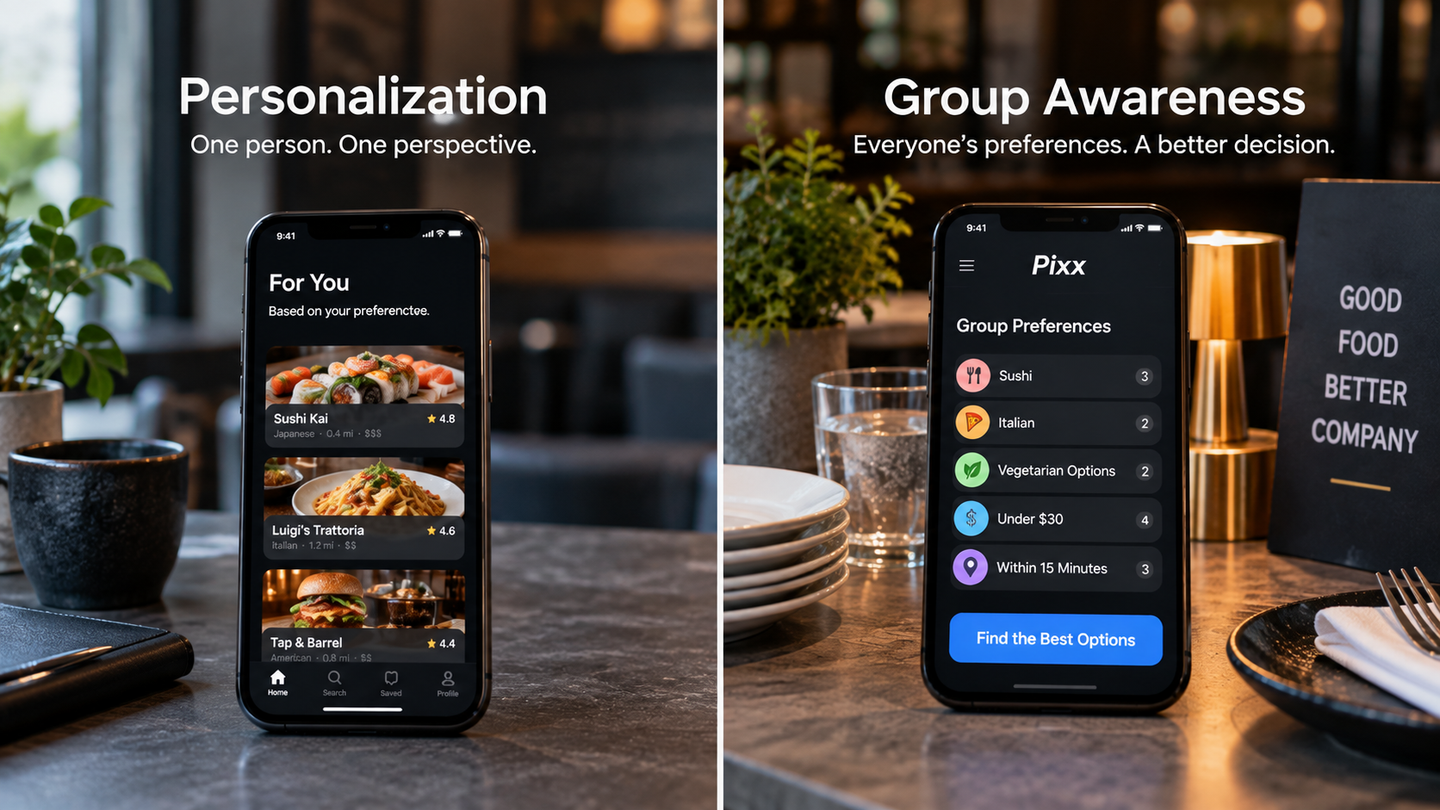
Restaurant discovery has spent years becoming more personal. Apps learn what you search for, where you eat, which cuisines you like and which restaurants you save. The goal is simple: understand one person well enough to recommend the right place.
That works when one person is choosing dinner.
The problem changes when four, six or eight people are eating together.
A group does not have one restaurant preference. One person wants sushi. Another wants Italian. Someone is vegetarian. Someone wants dinner under $30. Another friend wants somewhere close to home. A recommendation built around one person starts losing value as soon as everyone else enters the decision.
That is where group awareness becomes important.
Personalization asks, “What restaurant is right for you?”
Group awareness asks, “What restaurant works for everyone going?”
Those questions require different restaurant discovery systems.
Most restaurant apps still put one person in charge. That person searches, creates a shortlist and sends links to everyone else. The group then negotiates through texts, reactions and suggestions.
Restaurant discovery happened, but the decision is still unfinished.
This is one reason restaurant recommendations often break when more than one person is choosing.
Finding restaurants is rarely the hard part anymore. Search engines, maps, review platforms and restaurant apps already provide thousands of choices.
The harder problem is finding the restaurant that fits the group.
Group awareness starts by treating every person as part of the recommendation.
Imagine five friends planning dinner. Two want Asian food. One wants a burger. One person needs vegetarian choices. Someone wants to stay within 15 minutes. Another person cares more about price.
A personalized recommendation engine might give each person a different answer.
A group-aware system needs to look across those preferences and identify the strongest shared options.
That shift also changes how restaurant voting works.
Traditional voting often starts with a shortlist selected by one person. Everyone gets a vote, but one person still determined which restaurants entered the competition.
A group-aware process starts before the shortlist.
Everyone contributes preferences first. Restaurants are then suggested based on the group. Voting becomes the final step rather than the entire solution.
This is the model behind Pixx.
Create a meal, invite your friends and let everyone enter what matters to them. Pixx considers the group when suggesting restaurants, then gives everyone a simple way to vote.
The same approach becomes even more valuable when groups include different dietary restrictions, budgets or travel preferences.
Personalization will remain useful. People still need restaurant recommendations when choosing lunch alone, traveling or looking for something specific.
Social dining requires another layer.
As we discussed in our look at social dining trends, restaurant technology is moving beyond helping people find places. The next opportunity is helping groups make decisions together.
That is the difference between restaurant personalization and group awareness.
One understands the individual.
The other understands the table.
The next evolution of restaurant discovery will need both.