
How Pixx Adjusts Restaurant Recommendations Across NYC’s Five Boroughs
New York City is one dining market on a map, but Manhattan, Brooklyn, Queens, the Bronx, and Staten Island each behave differently. Pixx adjusts its restaurant recommendations by borough so groups get choices that better fit where they are, how far they want to travel, what they want to spend, and what kind of food they want.
· 5 min read
New York City has more than 8 million residents, thousands of restaurants, hundreds of neighborhoods, and five boroughs that each create a different dining experience. For Pixx, that matters because choosing a restaurant in Manhattan does not feel the same as choosing one in Queens, Brooklyn, the Bronx, or Staten Island.
Pixx already adjusts its restaurant recommendations based on the borough where a group is searching. The goal is simple. A group should see options that make sense for where they actually are, rather than receiving the same type of recommendations everywhere in New York City.
Manhattan is the densest borough in the city, with roughly 1.6 million residents and more than 74,000 people per square mile. Median household income is also among the highest in New York City, at roughly $104,000 to $106,000. The borough combines residents, commuters, office workers, tourists, students, theatergoers, sports fans, and convention visitors in a relatively small geographic area.
That density changes the restaurant decision. A place that looks close on a map might still mean a long walk through Midtown or an inconvenient subway transfer. Pixx accounts for that by making nearby options more relevant in Manhattan and recognizing that walking time often matters more than straight-line distance.
That becomes especially important around major venues. Groups heading to Madison Square Garden face the same restaurant question before Knicks games, Rangers games, concerts, and other events. Read our guide to where to eat before a Knicks or Nets game or our guide to choosing a restaurant before a Rangers, Devils, or Islanders game.
Brooklyn creates a different challenge. With more than 2.7 million residents, it is New York City’s most populous borough. Population density is roughly 39,000 people per square mile, and median household income is around $80,000 to $81,000.
Brooklyn also contains very different restaurant environments within the same borough. Williamsburg does not dine like Bay Ridge. Park Slope does not look like Brighton Beach. Bushwick, Sunset Park, Flatbush, Downtown Brooklyn, and Prospect Heights each have their own restaurant mix.
Pixx accounts for those differences by treating the borough as a collection of distinct local dining areas rather than one giant restaurant market. A group near Barclays Center should see choices that fit Downtown Brooklyn, Fort Greene, Prospect Heights, and surrounding neighborhoods. A group farther south in Brooklyn should see a completely different set of options.
Barclays Center is a good example of why local context matters. Nets games, concerts, and other events bring groups into Brooklyn who often want dinner before or after the event. Our Knicks and Nets dining guide looks at how Pixx helps groups make that decision around both Madison Square Garden and Barclays Center.
Queens adds even more variety. The borough has roughly 2.3 million residents, around 22,000 people per square mile, and median household income near $86,000. Queens also has the largest foreign-born population of any New York City borough, with more than one million residents born outside the United States.
That diversity shows up directly in the food.
Flushing, Jackson Heights, Elmhurst, Corona, Woodside, Jamaica, Astoria, and other Queens neighborhoods offer an enormous range of cuisines. A simple category such as “Asian” or “Latin American” does not tell a group enough.
Pixx adjusts its recommendations in Queens by recognizing more specific cuisines and neighborhood restaurant patterns. A group looking for Korean barbecue, Sichuan food, Thai food, Filipino food, Bengali food, Mexican food, Colombian food, or another specific cuisine should see choices that reflect what is actually available around them.
Travel also works differently in Queens. A restaurant might be geographically close but inconvenient by subway or bus. Pixx takes that local context into account when presenting options to a group.
Queens also becomes a major restaurant decision point around Citi Field. Friends heading to a Mets game often have to choose between eating close to the stadium, meeting elsewhere in Queens, or exploring restaurants in Flushing. Our guide to where to eat before a Yankees or Mets game looks at that exact group decision.
The Bronx has roughly 1.4 million residents and a population density of about 35,000 people per square mile. Median household income is lower than in the other four boroughs, at roughly $46,000 to $49,000. The borough also has strong Latin American and Caribbean communities and a restaurant culture that reflects those communities across many neighborhoods.
Pixx adjusts recommendations in the Bronx by keeping local options front and center. A group near Yankee Stadium should see restaurants that fit the actual area around the stadium and nearby neighborhoods, rather than recommendations dominated by Manhattan businesses.
That local focus becomes especially useful on Yankees game days. Friends coming from different parts of the city, New Jersey, or Connecticut often need one place to meet before the game. Pixx helps the group make that decision together, which is also covered in our Yankees and Mets restaurant guide.
Price also matters differently from one group to another. Pixx does not assume what someone wants based on income or ZIP code. Instead, borough-level context helps shape the restaurant pool while the group’s own preferences remain more important.
Staten Island is different from all four other boroughs. The borough has about 500,000 residents and roughly 8,600 people per square mile, making it far less dense than Manhattan, Brooklyn, Queens, or the Bronx. Median household income is around $98,000, one of the highest levels in the city.
That lower density changes how people think about restaurant distance.
In Manhattan, a restaurant several miles away might be impractical. On Staten Island, driving a few miles for dinner is far more normal. Parking, driving time, larger groups, and restaurant accessibility matter more.
Pixx adjusts for those differences rather than using the same distance expectations everywhere in New York City.
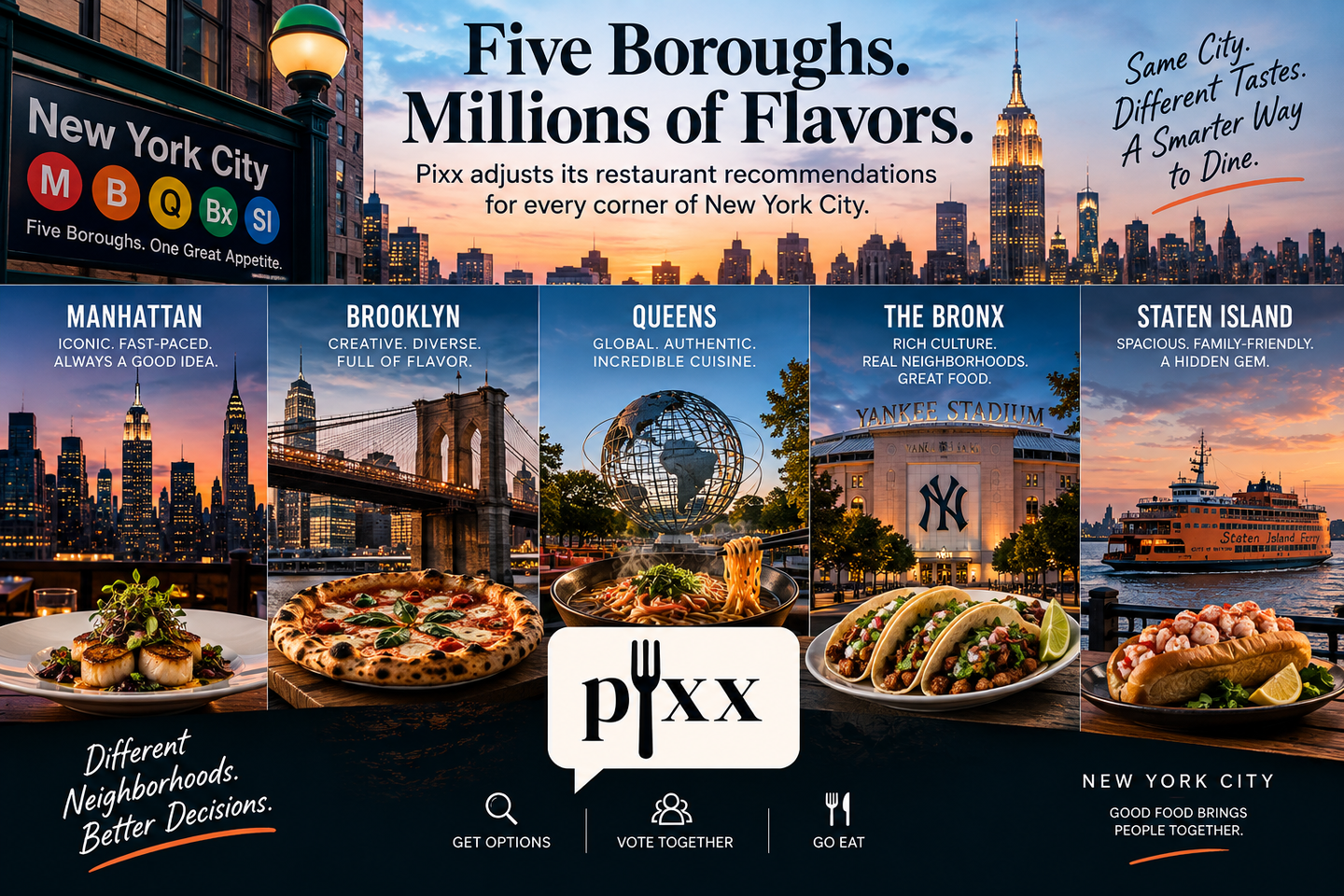
The differences among the five boroughs also go beyond density and income. New York City has one of the most diverse populations in the world. More than one-third of residents are foreign-born, and millions of New Yorkers speak a language other than English at home.
That diversity affects what groups want to eat and how specific their preferences become.
A group in Queens might be looking for a very specific regional cuisine. A group in Manhattan might care more about proximity to a Broadway show. A Brooklyn group might be choosing between several neighborhoods. A Bronx group might be meeting before a Yankees game. A Staten Island group might be driving together and care more about parking and table size.
The same principle applies to major events throughout the city. Whether friends are heading to a basketball game, baseball game, hockey game, soccer match, concert, festival, or another event, Pixx helps the group answer the same question: where should we eat?
For soccer groups, our guide to where to eat before a Red Bulls, NYCFC, or Gotham FC game shows how location and venue affect the restaurant decision across New York and New Jersey.
Pixx recognizes those differences before presenting restaurant choices.
The group still makes the final decision.
That is the important part.
Pixx does not decide what New Yorkers should want based on borough demographics. It uses location and local dining context to make the restaurant choices more relevant, then lets the people in the group vote based on what they actually want that day.
Two groups standing on the same block might still receive different outcomes because one wants sushi, another wants pizza, one has a tight budget, another wants a special dinner, and one group is willing to travel farther than the other.
The borough improves the starting point.
The group determines the answer.
That matters in New York because the city does not have one restaurant culture. It has five boroughs, hundreds of neighborhoods, thousands of restaurants, and millions of individual preferences.
Pixx adjusts to that reality so a group in Manhattan does not get treated like a group in Staten Island, and a group in Flushing does not get treated like a group in Williamsburg.
The question stays the same across all five boroughs.
Where should we eat?
Pixx makes the answer more relevant to where your group actually is.